
In Pikisaari, a small island with a layered industrial and cultural history at the mouth of the Oulujoki River, the design of a light art path did not begin with luminaires, drawings, or technical specifications. It began with people: residents, associations, city officials, cultural professionals, and researchers sitting together to discuss what darkness means, what should be protected, and where light could — carefully — be allowed to intervene.
Rather than treating lighting as a purely technical or aesthetic operation, the University of Oulu’s Faculty of Architecture structured the Pikisaari pilot as a long-term co-design process. Over the course of 2025, this process gradually built a shared understanding of the site, its values, its tensions, and its possibilities, through a sequence of meetings, workshops, public events, and on-site experiments. The outcome is not only a preliminary lighting concept, but also a collective reframing of Pikisaari as a place where darkness itself is a cultural, ecological, and experiential asset.
Mapping the social and spatial landscape
The process began with extensive context mapping, drawing on written sources and a series of expert interviews. It then continued with a stakeholder mapping exercise that identified around 50 individuals from some 30 organisations and sub-organisations connected to Pikisaari in different ways — including residents, local associations, cultural and creative professionals, city departments, and site users.
This mapping already revealed a central challenge: Pikisaari is not a single community but a mosaic of interests — recreational, residential, cultural, ecological, historical — that do not always align neatly.
The first co-design meeting, held in March 2025 in Pikisaari, brought together 11 participants alongside four researchers from the University of Oulu. The aim was not to present solutions, but to launch a process and test whether there was willingness to engage over time.
Participants were asked to introduce themselves not only by name or role, but by the perspective they brought to the question of “dark-time Pikisaari”. This immediately surfaced a diversity of views: appreciation of the beauty of darkness, concern about light pollution, attachment to nature, interest in tourism and placemaking, and sensitivity to the site’s fragile heritage. Stories and anecdotes about the island played an important role, grounding abstract discussions in lived experience.
What emerged was a cautious but genuine interest in co-design as a method — not only to influence outcomes, but to learn collectively. The meeting also expanded the stakeholder map, as participants suggested additional people and groups who should be involved.
From values to scenarios
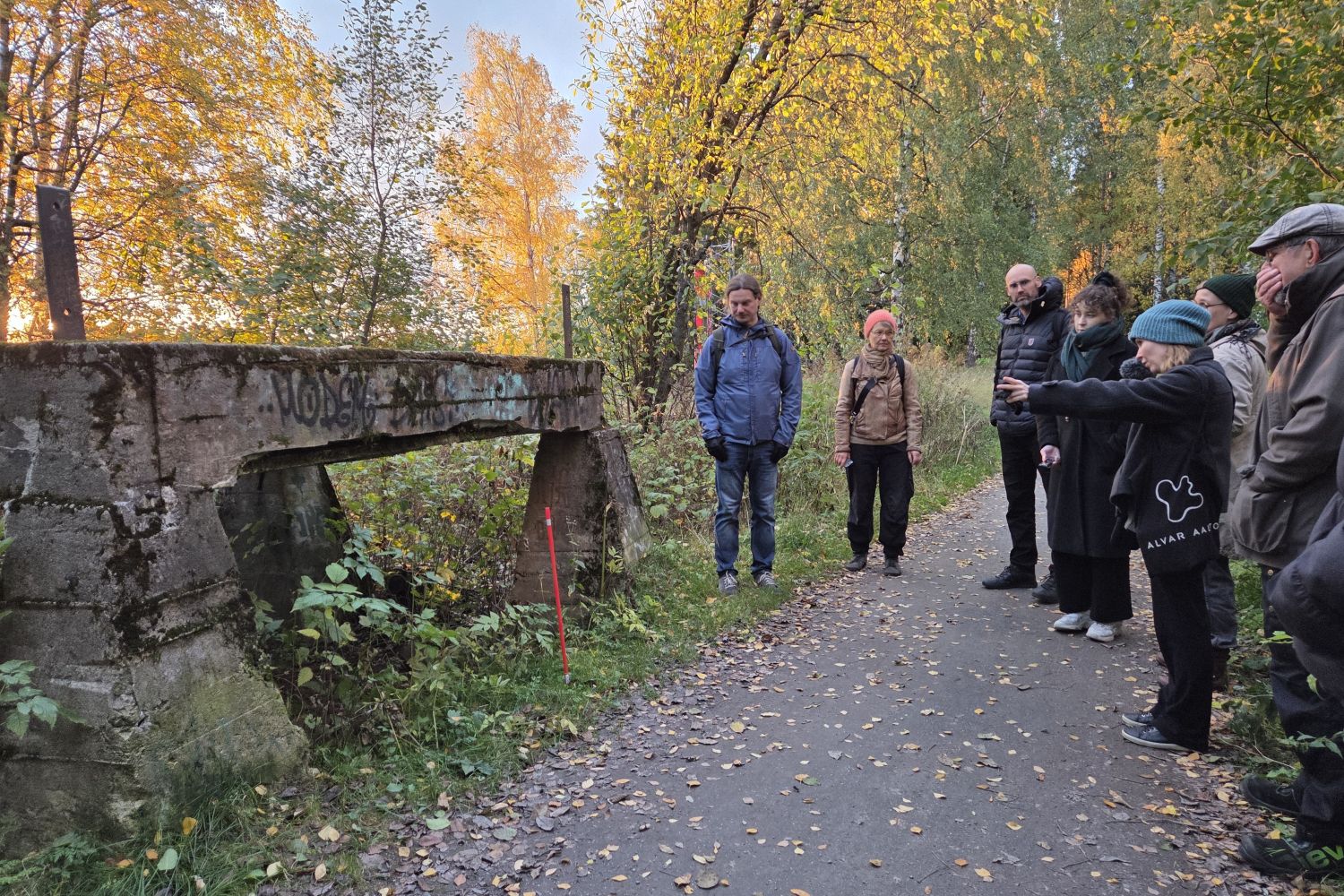
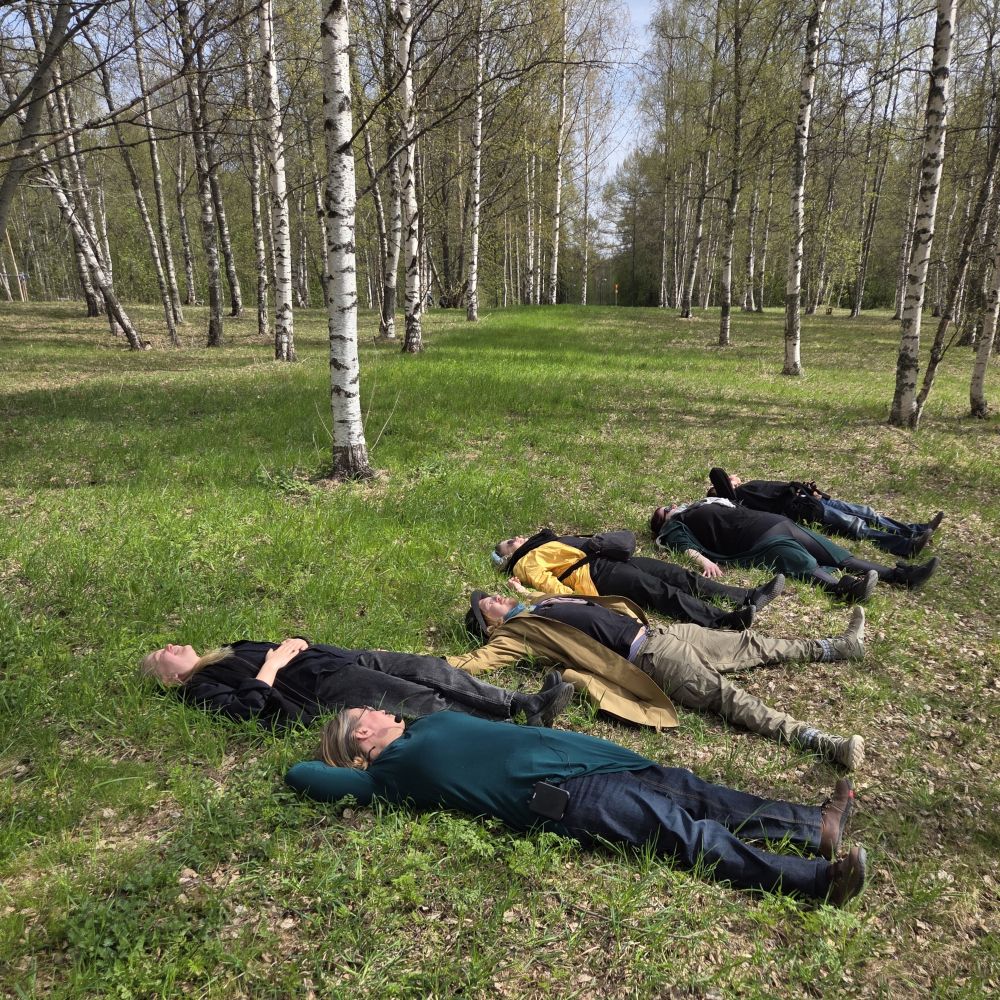
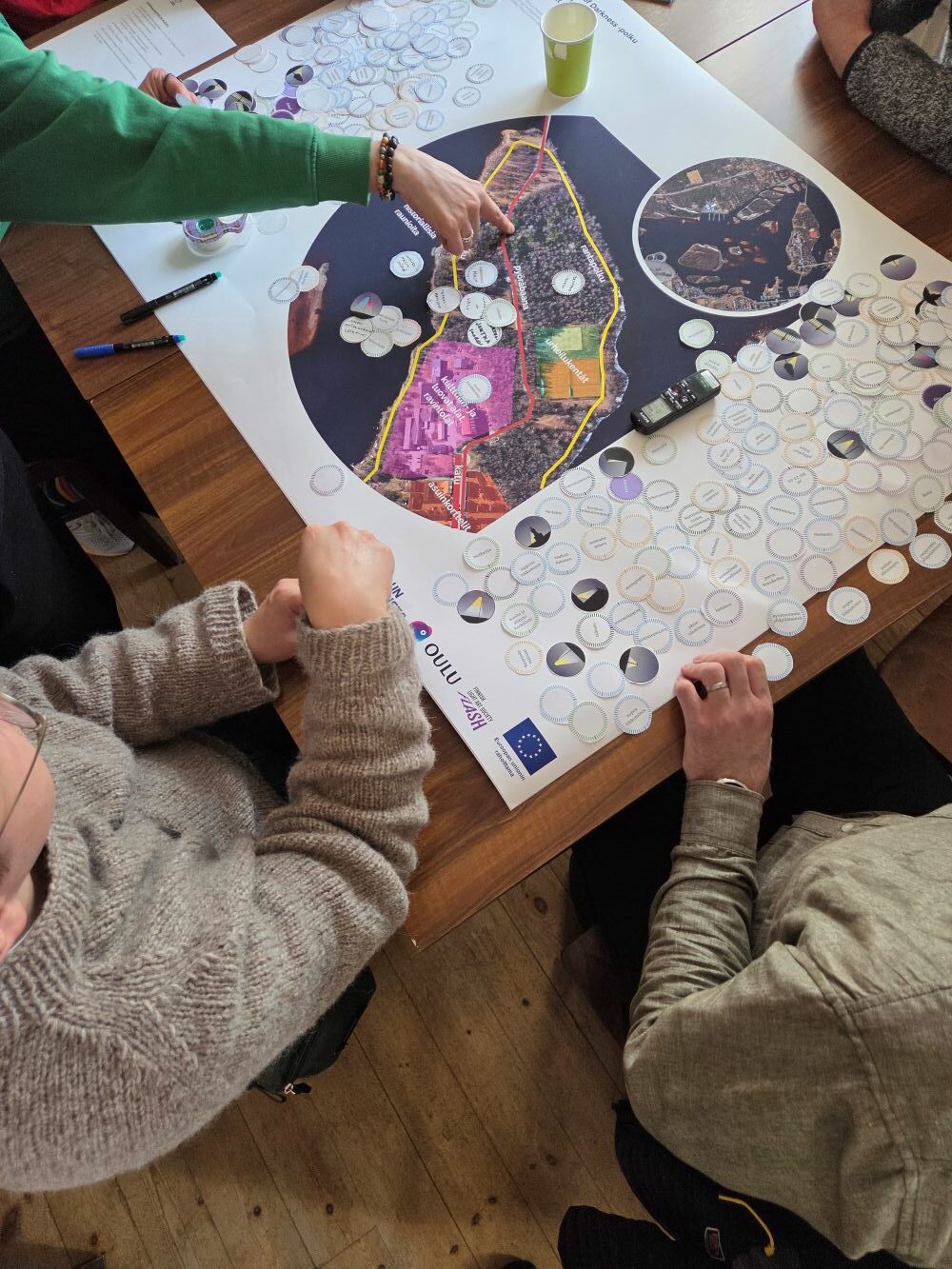
The second step, a scenario workshop in May 2025, moved from open discussion toward structured ideation. Nine participants and five researchers gathered to explore how cultural environment, nature, art, and dark-time experiences could be linked along a future path in Pikisaari.
The workshop combined a walk on the island with an indoor “scenario game” in which participants worked in groups to imagine different forms of dark-time experience. This hybrid format — physical immersion followed by conceptual abstraction — proved crucial. Observations made during the walk (about openness of views, intimacy of certain spaces, transitions between natural and built environments) fed directly into the scenarios.
Several principles began to crystallise: the importance of variation rather than uniformity, the need to respect moments of complete darkness, and the idea that light should “invite” rather than dominate. Participants also showed increasing commitment; many had already attended the first meeting, and a shared language around light, dark, and experience started to form.

Opening the process to the wider public
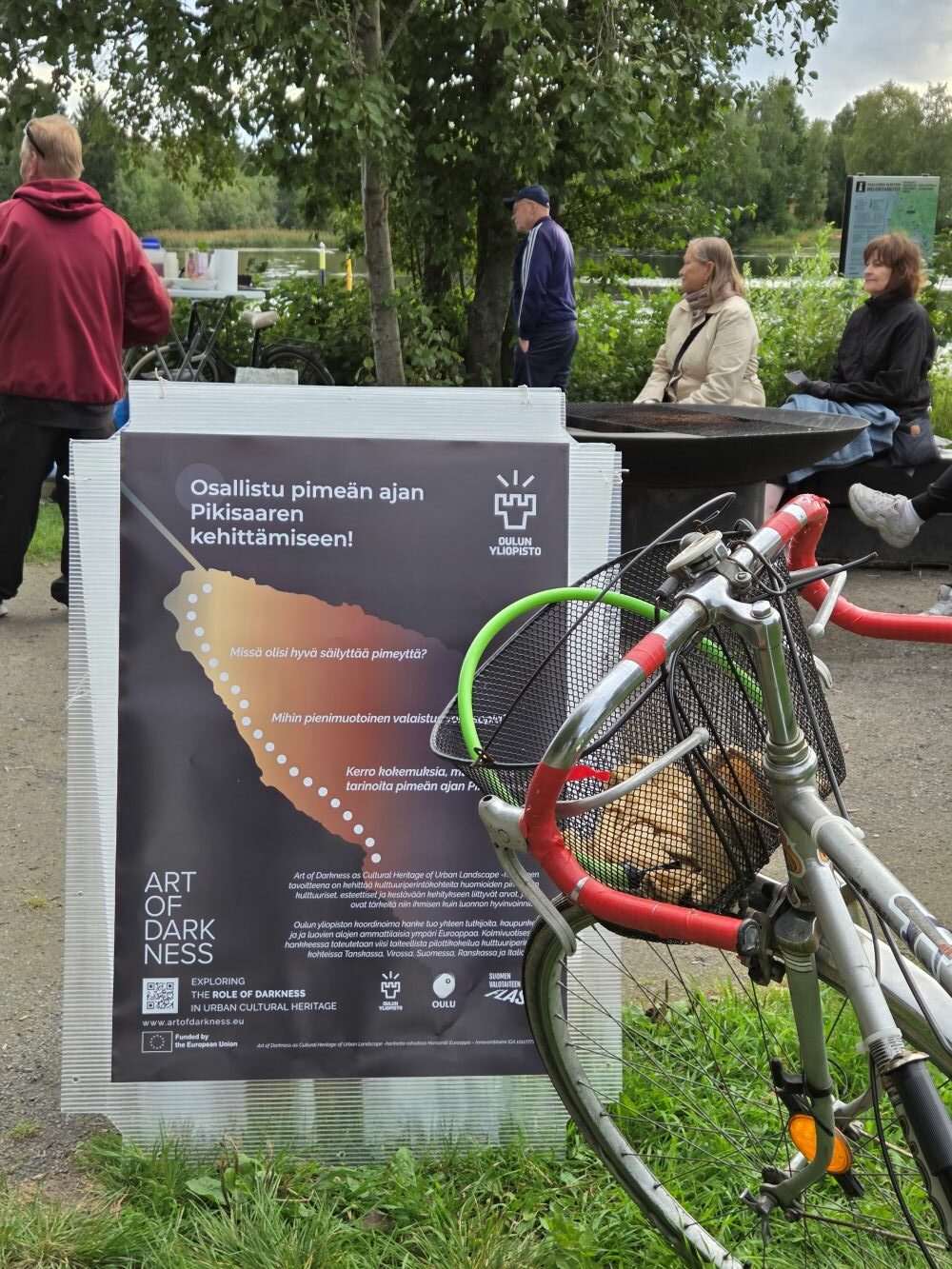
Until that point, the process had primarily involved identified stakeholders. A pop-up event on 23 August 2025 was designed to open it to a broader public — especially those who use Pikisaari casually and would never respond to a formal stakeholder survey.
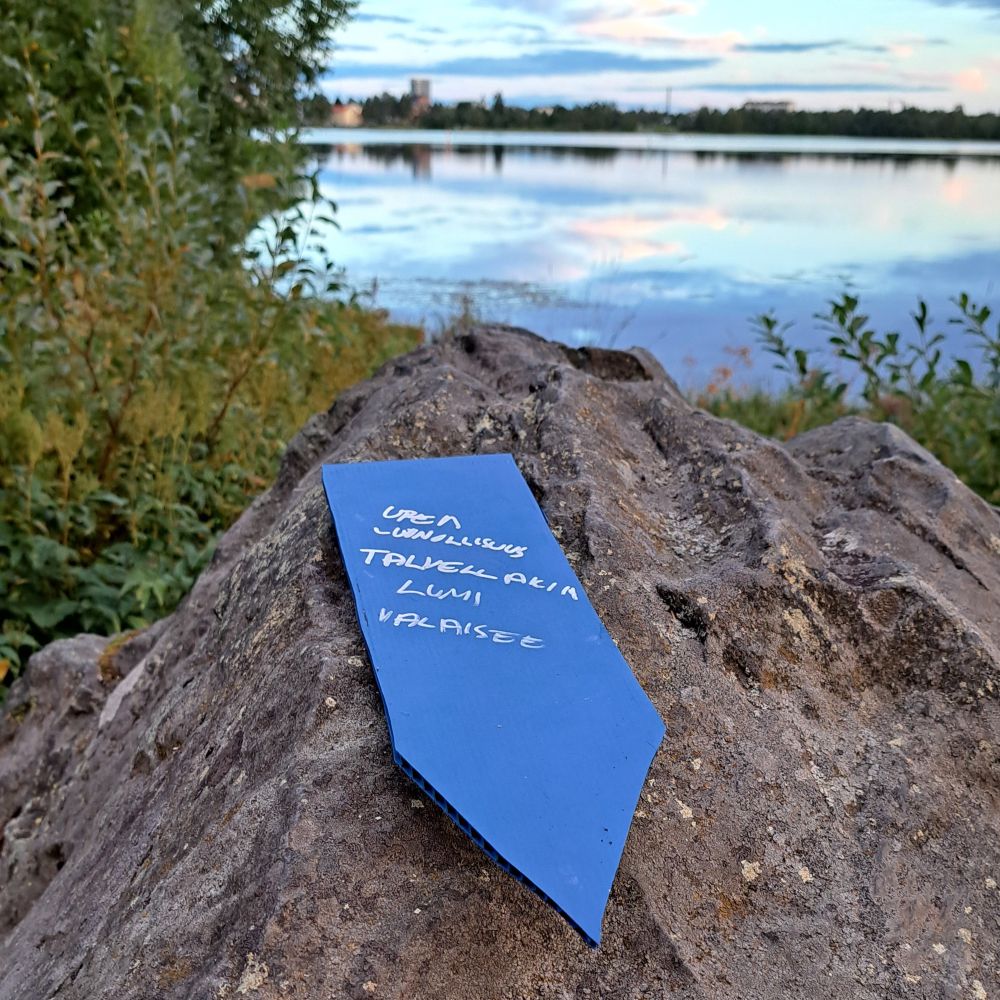
Held in late summer, the event attracted around 30 participants and combined information sharing with on-site micro-workshops. Passers-by were invited to mark places on site where darkness should be preserved and where small-scale lighting might be acceptable, and to share memories or experiences of Pikisaari in the dark season. A local musician, Jukka Takalo, helped draw people in, and the event extended into twilight, ending with a campfire by the shore.
Associate Professor Henrika Pihlajaniemi, who coordinates the project, described the aim as creating “a safe and inviting way to enjoy Pikisaari and the river delta’s natural darkness, the island’s industrial history, and its cultural layers — through subtle, artistic use of light”. The pop-up made this ambition tangible, as discussions were anchored in specific places, atmospheres, and sensory impressions.
This event confirmed two important points. First, it reached people who had not previously participated in the process, expanding its social base. Second, it generated design insights that could only emerge on site: how the character of the path changes over short distances, how views open and close, how water, vegetation, and built elements interact differently depending on direction and time of day.
Translating insights into a preliminary concept
By early autumn, the accumulated material from meetings, workshops, and the pop-up had been synthesised into a preliminary concept. This was reviewed on site in September 2025 with representatives from the City of Oulu, including engineers responsible for public lighting, the head gardener, a museum archaeologist, and an innovation manager.
The core ideas conveyed to the city were clear:
- Lighting should not replicate standard route lighting but be meaningful and aesthetically intentional.
- Light should highlight the specific nature and history of Pikisaari.
- Small-scale, low-level, warm, glare-free lighting is preferable.
- Rather than uniform illumination, patches of light should guide and invite.
- Lighting must not encourage a faster cycling traffic.
- Darkness itself must remain an option; lighting should be selective and potentially switchable.
- Nature and archaeological remains must not be damaged in implementation.
This review functioned as a translation moment: transforming qualitative, experiential insights into constraints, parameters, and feasibility considerations. It also established cooperation between researchers and city experts, ensuring that the concept could be realised without compromising heritage or ecology.
Testing light and darkness together
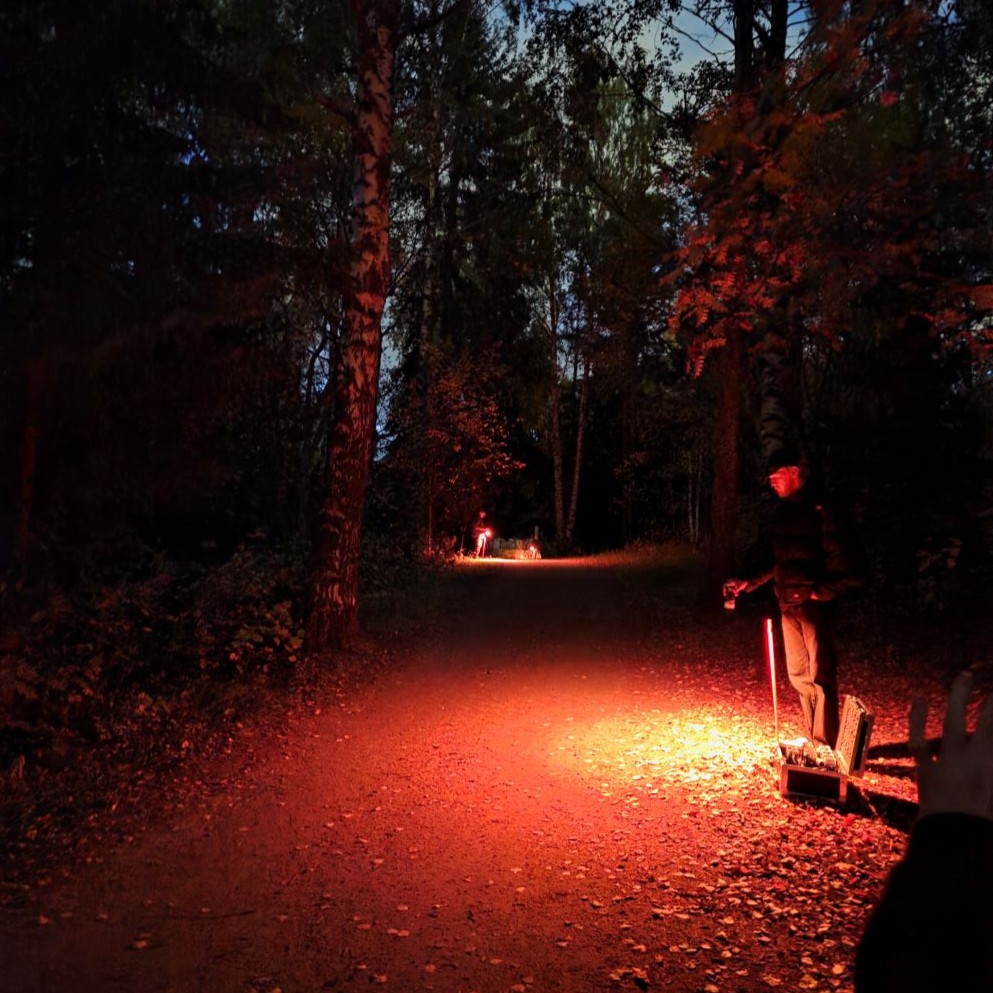
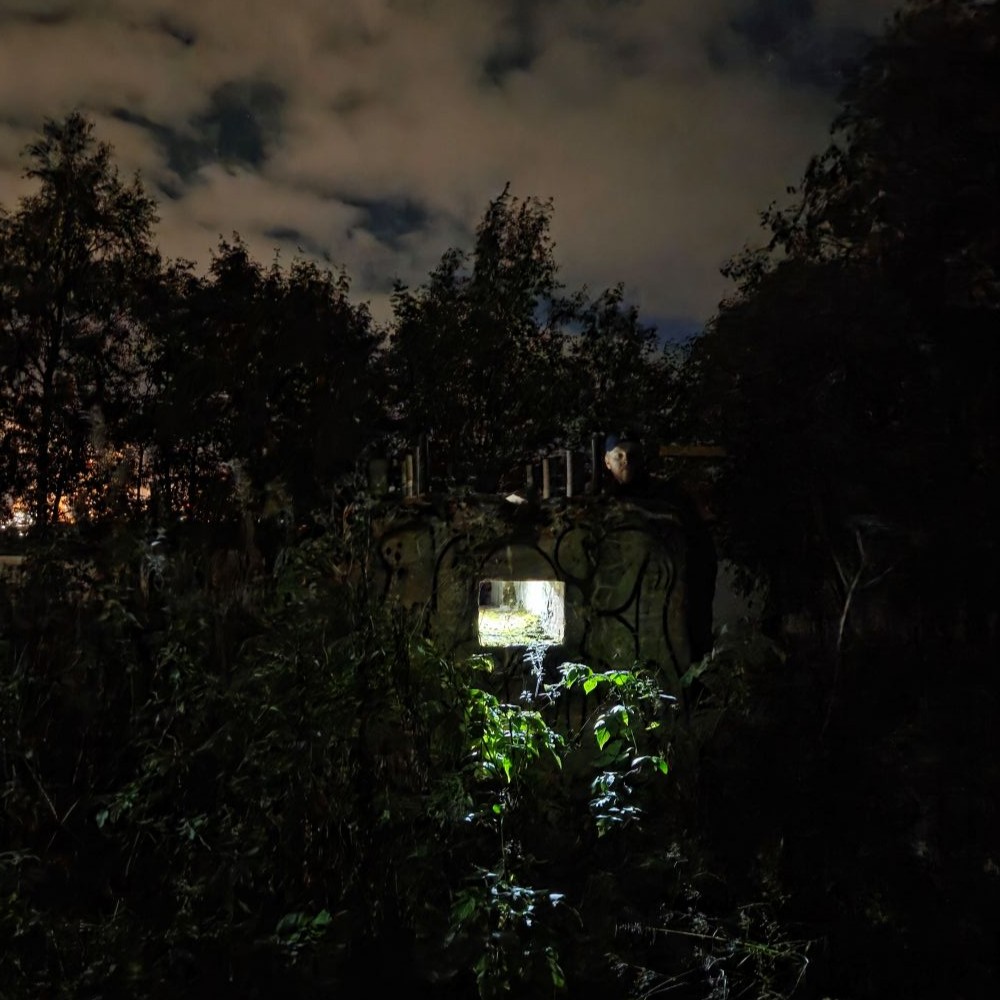
The fifth key moment was the “experiments of light and dark” workshop later in the autumn. Participants who had been involved earlier returned to the site for an evening session combining reflection and testing.
The group first revisited the path before nightfall, identifying where darkness felt essential and where light could add value. As darkness fell, they experimented with fixture positioning, beam shapes, colour temperatures, and patterns, including lighting for shoreline sections and historical ruins.
This stage made explicit that co-design was not only about opinions but about shared sensory evaluation. Participants could experience directly how subtle changes in tone or direction altered atmosphere, legibility, and comfort — and how easily light could become intrusive if not handled carefully.
A process still in motion
What distinguishes the Pikisaari process is not only its sequence of events but its logic: alternating between inclusion and synthesis, between open participation and focused expert translation, between discussion and physical testing. Each phase built on the previous one, slowly transforming a diverse set of voices into a coherent — though deliberately non-final — concept.
Importantly, the process is ongoing. Map-based surveys are still running, an educational programme is underway and further experiments are planned, and the final form of the light art path will continue to evolve.
In Pikisaari, co-design has functioned less as a consultation exercise and more as a method for collectively redefining what it means to design with light in a sensitive cultural and ecological context, treating darkness as a quality to be understood, valued, and carefully curated.
Photos: © Outi Parhankangas & Henrika Pihlajaniemi